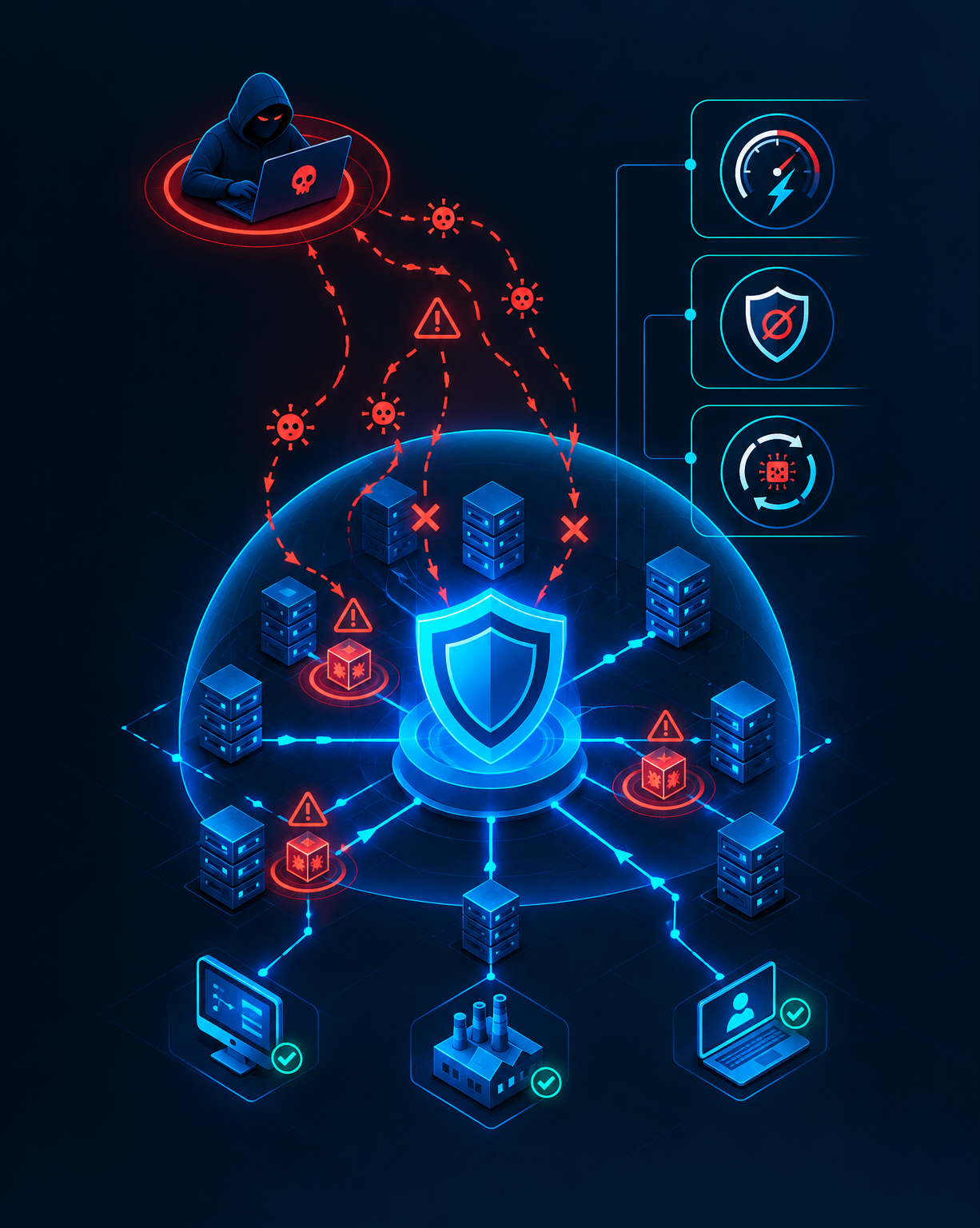
i-Mirage surrounds your real infrastructure with high-fidelity interactive decoys. Across IT, OT/ICS, cloud, and telecom signalling — the moment an attacker strikes a decoy, they are caught.
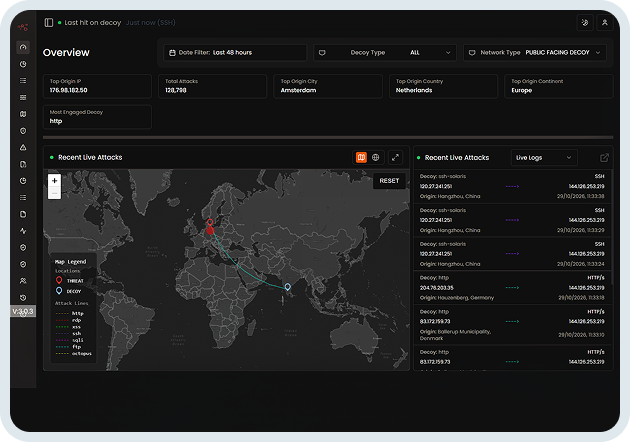
Average time to identify and contain a breach (IBM Cost of a Data Breach Report 2026), versus instant alerts with i-Mirage
Reflex response speed to isolate target at machine speed
False positives. Only attackers touch deception assets
Native domains: IT, OT/ICS, Cloud, and Telecom signalling
Leaves critical on-prem, OT, and telecom signallings blind and exposed.
Guesses intent based on messy log traffic, generating endless alerts.
Security teams spend hundreds of hours filtering white noise and false positives.
Must constantly be retrained to your environment or it becomes useless.
Universal coverage across every operational domain you run natively.
The alert is generated because a decoy was touched. It’s proof of malicious intent.
No legitimate user ever touches a decoy, so every alert is a real event.
Intelligent layout placement forces lateral movements straight into traps.
Deploy decoys native to each environment — not a generic honeypot behind one infrastructure it doesn’t understand.

Active Directory deception, fake credentials injected dynamically into memory, and realistic file shares.

Deception native to power, utility and rail grids, and IoT devices. Simulated SCADA, PLC registers and HMI structures.

AWS, Azure, and GCP native honey-tokens, simulated containers, and decoy serverless functions.

Simulated core infrastructure detecting signaling attacks on SS7, Diameter, and GTP protocols.
Five steps, running continuously, with no added headcount and no production risk.

Decoys are positioned and repositioned dynamically across the estate.
01
Every interaction is scored for malice and intent — not just logged.
02
Attacker lifecycle is mapped automatically against MITRE ATT&CK.
03
Verified signals push straight into your SIEM and SOAR, with EDR and XDR integration on request.
04
Daily, automated, board-ready reporting — no manual write-up.
05Isolate malicious entities at hardware speed.
Genuine users don’t trigger deceptive triggers.
Whether the intrusion is a long human-led state campaign or an automated worm, the physical interaction of touching a decoy is a constant. We break the execution loop immediately.
Supported by leading government, academic and venture institutions in India.






Real interceptions and real deployments — not hypothetical scenarios.
“An attacker used a stolen domain admin credential to query AD. Our AD deception modules dynamically injected a deceptive credential which pointed directly to a simulated crown-jewel file share. Attacker immediately attempted connection and was instantly locked out before writing any persistence.”
Caught in the Act: a MySQL UDF exploit chain, unpacked byte by byte inside the protocol stream
T1190 (Exploit Public-Facing App)
T1105 (Ingress Tool Transfer)
T1027 (Obfuscated Files)
An attacker reached a decoy database server emulating a Windows MySQL instance, smuggled a packed UDF DLL into it as a hex blob inside the SQL session, and used it to run OS commands in a 19-step chain, every byte captured. Staging servers, the exfiltration host and a Tor-based ransom channel were extracted before any production system saw the same actor. The source IPs appeared on public threat-intel feeds weeks later.
Caught in the Act: planted evidence-share credentials, used almost as soon as they were seeded
T1021 (Remote Services)
T1083 (File & Directory Discovery)
T1005 (Data from Local System)
A decoy case-management server and a set of planted evidence-share credentials sat where only an intruder would go looking. An external actor authenticated with those credentials, enumerated the share and began pulling decoy case files, activity no analyst or officer had any reason to generate. The full session, from the commands run to the source infrastructure behind it, reached the investigating team as a timestamped evidence package rather than a SIEM alert.
Caught in the Act: five attacker IPs the firewall, WAF and SIEM had all let through
T1595 (Active Scanning)
T1110 (Brute Force)
T1078 (Valid Accounts)
Five source IPs worked the decoys with wordlist requests and credential brute-force. We cross-checked the customer’s own SIEM: their firewalls and WAF had allowed 543 of those actors’ 588 events, and the 35 ‘blocks’ were plain port rules, not threat detection. Domestic ISP addresses over ordinary HTTPS look like nothing until they touch a server no legitimate user has a reason to reach.
Caught in the Act: a contractor VPN session that went looking for the building-management network
T1133 (External Remote Services)
T1046 (Network Service Discovery)
T1021.001 (RDP)
A session on a third-party maintenance VPN began sweeping the operational segment for Modbus and RTSP endpoints, traffic a baggage-handling or BMS contractor never generates. It reached our camera and controller decoys first. The session was traced to a compromised contractor laptop and cut off before the real control network was touched.
Caught in the Act: reverse shells hidden in SIP headers, 2,947 attackers deep
T1595 (Active Scanning)
T1110 (Brute Force)
T1059 (Command & Scripting)
Across a 29-day live run for an operator with roughly 200 million subscribers, a SIP/VoIP decoy and an API decoy drew 547,739 attack events from 2,947 unique source IPs. 1,966 were direct attempts to compromise the SIP stack, including reverse-shell commands concealed inside SIP headers, and attackers dialled 49,884 destination numbers in toll-fraud attempts, a ready-made block list for the fraud team.
Founded in 2021 as a deep-tech spin-out from IIT Kanpur, designed to turn the tables on elite hostile threat groups.








Backed by a distinguished national defense and industrial security advisory board with operations spans in financial centers and critical infrastructure nodes.
Expert analysis, threat intelligence reports, and deception technology deep-dives.
By Treacle Technologies You’ve probably seen the headlines by now — one of India’s largest public sector banks confirmed a security incident after...
Read more
Caught in the Act: How Our Decoy Intercepted a Sophisticated APT Attack Targeting India’s Financial Sector On the evening of May 7, 2025,...
Read more
In today’s ever-evolving cybersecurity landscape, organizations face a mounting challenge: how to detect and mitigate cyber-attacks swiftly enough to prevent them from escalating...
Read moreDeployed across banking, government, airport and critical-infrastructure environments, i-Mirage supplies the definitive physical evidence path required by modern cyber threat reporting directives.


Zero downtime deployment. Simple non-intrusive implementation.
Agentless in OT/ICS. Absolutely zero host risk to core process plants.
Full audit trail per incident, proving intent and exfiltration scope.
MITRE ATT&CK mapped evidence ready for defense boards.
Board-ready automated incident forensics, generated Agentless deployment, typically live in weeks, not months, starting with a scoped proof-of-value pilot.
Everything you need to know about i-Mirage active deception technology and how we proactively safeguard your enterprise from lateral cyber threats.
Active deception technology goes beyond traditional honeypots by deploying dynamic, high-fidelity decoys that mimic real assets across your entire infrastructure. Unlike static honeypots, i-Mirage decoys adapt to your environment, are repositioned automatically, and generate near-zero false positives — every alert represents a confirmed threat interaction.
i-Mirage is agentless, so nothing is installed on endpoints or production systems. Agentless deployment is typically live in weeks, not months, starting with a scoped proof-of-value pilot.
Near-zero. No legitimate user or system has a reason to touch a decoy, so any interaction is hostile by design. Every alert carries the source, protocol, payload and MITRE ATT&CK mapping.
T and identity (including Active Directory), OT/ICS including air-gapped networks, IoT, cloud and telecom signalling, all managed from one console.
Alerts flow into your existing SIEM, SOAR and SOC workflow, including Splunk, QRadar and Microsoft Sentinel, using syslog, CEF and API. i-Mirage complements your current stack; it does not replace it.
Request a scoped, risk-free proof of value pilot. Catch unauthorized lateral movement in real-time.